

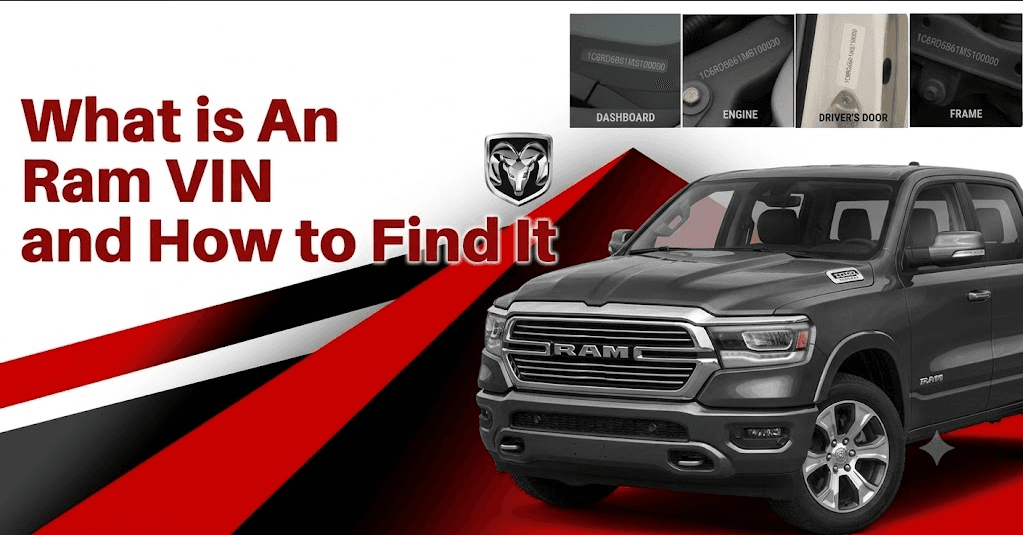
The Vehicle Identification Number (VIN) is the truck's unique identifier. It is the most critical unique identifier for registration, insurance, warranty claims, and verifying the authenticity of a used vehicle. Whether you own a modern Ram 1500, a heavy-duty 3500, or a vintage Dodge D-Series, the VIN helps confirm the factory build sheet, engine specifications, and transmission details.
Key Takeaways:
- A VIN is a unique 17-character code that identifies every Ram individually.
- On modern Rams, the VIN is located on the driver’s side dashboard (visible through the windshield) and on the driver’s side door jamb (B-pillar) sticker.
- The VIN also appears on all official paperwork, including the title, registration, and insurance documents.
- Using a Ram VIN decoder lookup, you can accurately confirm the engine size, drivetrain, cab configuration, and more at no cost and without memorizing the code structure.
What Is a Ram VIN?
A Ram VIN is a Ram Vehicle Identification Number, a standardized serial number used by the automotive industry to identify individual motor vehicles. For Ram trucks, this code is essential because two trucks that look identical on the outside can have vastly different powertrains (e.g., the 5.7L HEMI vs. the 3.6L Pentastar), axle ratios, or towing packages.
When you see a Ram truck for sale, the VIN is the "fingerprint" that tells you exactly how it left the assembly line. It connects the vehicle to its original build data, recall status, and other recorded information linked to the VIN.
The Difference Between Modern Ram and Classic Dodge Ram Chassis Numbers
The history of Ram VINs is divided into two distinct eras, much like the brand’s split from Dodge.
The Modern 17-digit Ram VIN Era (1981–Present)
Beginning with the 1981 model year, the U.S. automotive industry adopted the standardized 17-character VIN format under federal regulations. This applies to all modern Ram trucks, including the 1500, 2500, 3500, and the ProMaster vans. This system is universally recognized and used for modern vehicle identification.
The Classic Pre-1981Era (Chassis Numbers)
Before 1981, Dodge trucks (which eventually became the Ram brand) used a shorter, non-standardized chassis number or serial number. These numbers varied by model and year, often ranging from 6 to 13 digits. For example, a 1970 Dodge D100 uses a different numbering convention than a 1979 Power Wagon. Decoding these older trucks requires model-specific knowledge rather than a universal formula.
How a Modern 17-Character Ram VIN Works
All modern Ram trucks use the ISO 3779 standard 17-character VIN. The code uses numbers (0-9) and letters (A-Z), excluding "I", "O", and "Q," to prevent confusion with numbers. The VIN is broken into three global sections:
- World Manufacturer Identifier (WMI): Characters 1–3 identify the manufacturer (Ram/Dodge).
- Vehicle Descriptor Section (VDS): Characters 4–9 describe the truck's configuration, including the model, engine type, safety systems, and the check digit.
- Vehicle Identifier Section (VIS): Characters 10–17 represent the model year, assembly plant, and the unique production sequence number.
A Ram VIN helps identify:
- Manufacturer (Ram vs. Dodge)
- Model (1500, 2500, 3500)
- Model Year
- Engine Type (HEMI, EcoDiesel, Hurricane)
- Cab Style (Crew, Quad, Regular)
- Drivetrain (4x4 vs. 4x2)
- Assembly Plant (Sterling Heights, Saltillo, Warren)
- Production Sequence
Example of a 17-Character Ram VIN (1C6RR7FT5JS123456)

Let's break down a typical VIN from a 2018 Ram 1500 to show how the data is structured:
| VIN Position | Value | Meaning |
|---|---|---|
| 1 | 1 | Manufactured in the United States |
| 2 | C | Chrysler (FCA/Stellantis) |
| 3 | 6 | Ram truck |
| 1-3 | 1C6 | WMI: Ram Trucks (USA) |
| 4 | R | Ram pickup series |
| 5 | R | Ram 1500 |
| 6 | 7 | Crew Cab configuration |
| 7 | F | 4WD drivetrain (Ram light-duty configuration) |
| 8 | T | 5.7L HEMI V8 gasoline engine |
| 9 | 5 | Check digit (used to validate the VIN) |
| 10 | J | 2018 model year |
| 11 | S | Warren Truck Assembly Plant, Warren, Michigan, USA |
| 12-17 | 123456 | Sequential production number |
← Scroll horizontally to see more →
Every VIN position identifies a specific vehicle attribute. You don’t need to interpret these characters manually. Our free Ram VIN decoder tools can pull this data in seconds, without you having to remember what each code means.
How a Pre-1980s Classic Dodge Ram VIN Works
For classic truck enthusiasts, decoding a pre-1981 Dodge D-Series or W-Series is a different process. Before the federal mandate, Dodge used several different numbering systems.
Unlike modern 17-character VINs, Chrysler/Dodge did not follow a single standardized VIN format before 1981. The meaning of several positions varies by model year and vehicle line. Based on Chrysler's 1980 VIN (A10JTAC123540) conventions and the information returned by your decoder, here's the decode.
| Position | Value | Meaning |
|---|---|---|
| 1 | A | Dodge Truck Division |
| 2-3 | 10 | Ramcharger model series |
| 4 | J | 360 cu in (5.9L) V8 engine |
| 5 | T | 2-door Utility Wagon (Ramcharger body style) |
| 6 | A | 1980 model year |
| 7 | C | Assembly plant (Chrysler truck plant code) |
| 8-13 | 123540 | Sequential production number |
← Scroll horizontally to see more →
Note: Classic Dodge numbers are not universal. A 1950s Power Wagon uses a completely different prefix system than a 1970s D100.
Unlike modern VINs, classic Dodge truck VINs were assigned before the federal 17-character standard was introduced in 1981. Because Chrysler used different numbering systems across model years and truck lines, the same character may represent different information depending on the vehicle.
For that reason, decoding a pre-1981 Ram or Dodge truck requires year-specific references or a decoder that supports classic VIN formats. Rather than trying to interpret these older numbering systems yourself, use a specialized Ram VIN decoder to identify the vintage Ram trucks.
Where to Find the VIN on a Ram
Finding the VIN is the first step in verifying your truck's identity. For modern Ram trucks, the VIN is located in standard, easy-to-inspect locations.

On the Vehicle
- Driver’s Side Dashboard: Look through the windshield at the corner where the dashboard meets the glass. The VIN is on a metal plate stamped clearly.
- Driver’s Side Door Jamb (B-Pillar): Open the driver’s door and look at the sticker attached to the door frame. This sticker contains the VIN, tire pressure specs, and towing capacity.
- Under the Hood: On some models, the VIN is also stamped on the frame rail near the front right wheel well.
On Vehicle Documents
- Title Certificate
- Registration Documents
- Insurance Cards
- Service Records (Dealership records will always list the VIN)
For Pre-1981 Classic Dodge Trucks
On vintage Dodge trucks, the location is less consistent. The VIN (or chassis number) can typically be found on:
- A metal identification plate is riveted to the driver's side door jamb.
- A stamped number on the frame rail (usually on the right side, near the front suspension).
- A firewall tag is located on the passenger side of the engine bay.
Because classic Dodge trucks used multiple numbering systems depending on the production year, verifying the VIN against the title is critical to ensure the number matches the frame stamp.